By this stage in Japan I was beginning to feel the pinch on the pocket book. The 10,000 Notes seemed to be falling through my fingers in an uncontrollable fashion -with travel, food and boarding mounting to approximately £50 a day! I eventually made it to Nagasaki and stole out to the supermarket to get some food – I chose a box of fried tofu as a means o staving off of hunger at a supposedly sensible price only to discover that the tofu fry was an empty shell of nutrition-less husk! I made it to the youth hostel were I met with Noe and Hugo, a travelling duo (then couple) who I was to spend the next few days with. I was very jealous to discover that they were spending a full 5 months in the country travelling around.
We went out to Yoshinoya together and another restaurant on a later night where I hungrily devoured the husks of Edamame beans. A growing lad in Japan with not much money is hard pressed to adapt to the small Japanese portion sizes!
My time in Nagasaki was not very eventful. I wandered the city and took a few shots – getting lost for a time in Chuigomachi – a small zone of the city near the river with a large graveyard complex overlooking the river. I missed out on both the peace museum and the dutch island “Dejima” – famously the only place in Japan to accept foreign nationals throughout the entirely of the “Shut down” that occurred early into the Tokugawa Shogunate period.
The two photos here demonstrate another curious thing of how dirty my sensor was during this time. There is one particularly onerous hair that can be seen in the right of the picture. Compare the two versions. This has made my subsequent edits something of a repetitive challenge to clean!
I did manage to find my way to the monument for the Twenty-six Martyrs of Japan – a group who were burned alive in the 1600s for refusing to recant their christian protestations, having been converted by Jesuit missionaries looking to subvert Japan under the sway of Western Powers. The serial subterfuges of these ages where what eventually lead to the expulsion of foreigners from the islands – – – apart from the aforementioned dutch who distanced themselves on religious and political grounds from the catholic camp and were thus able to maintain a unique and lucrative trade foothold in the country for over 200 years.
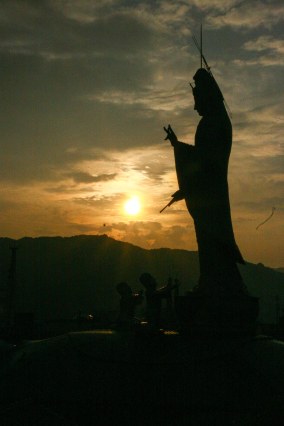

I was a pleasure meeting Noe and Hugo – a welcome relief from the loneliness of the previous week’s travel through the center of Honshu. We would go on to travel together to Aso-san, climbing the mountain before our paths diverged with the pair moving on south and the call for me to return to Tokyo before I boosted from Japan.
— — —
Seb 28-02-2014 London

Cat Fed Tofu

Children and the biker

Old man lighting up

Nagasaki city Hawks

Nagasaki Sunset

Nagasaki Chikugomachi

Mail man of Peace

Unsuspecting

Noe and Hugo

Peeing Boy

Noe

Seb 2006 Selfie

Noe and Hugo II

Nagasaki: Chikugomachi Buddha III

Nagasaki: 26 Martyrs of Japan

Nagasaki: Chikugomachi Buddha

Nagasaki: Chikugomachi Buddha II

Nagasaki: View across the bay

Yoshinoya Old man

Hugo and Noe III

Nagasaki Bay

Nagasaki Bay Fisherman




 Seb Roberts: Life as It happens